Money in, money out, and the statement for the meeting.
Bookkeeping for a family or a club. You record a date, an amount, an account, and a category — the double entry happens underneath, and the database refuses anything that does not balance.
Free and open source. No debits, no credits, no chart of accounts to learn.
Balanced
- came in
- $4,200.00
- went out
- $2,610.00
- left over
- $1,590.00
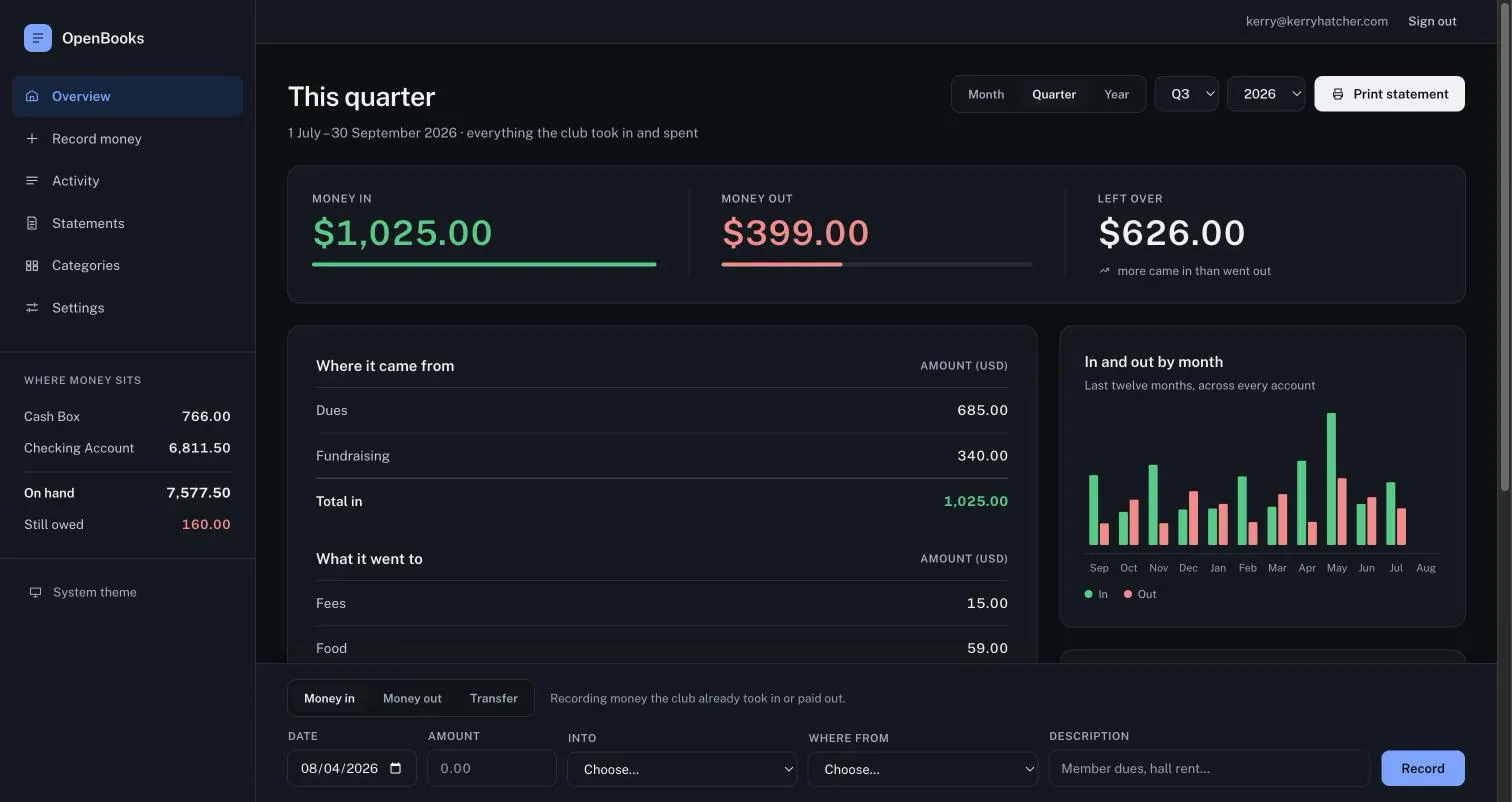
A quarter from the sample books — the club, and every figure on this page, ships with OpenBooks so you can click through a full year before you type anything.
Somebody made you treasurer. Your three options are all wrong.
A bank account, a cash box, and a meeting once a month where somebody asks what we spent on the field trip. Here is what that job usually gets done with.
A spreadsheet
Row 9 landed outside the range in March. The total has been wrong ever since, and it still looks right.
Real accounting software
It wants a chart of accounts, journal entries, and a working knowledge of which side a debit lives on. You volunteered to hold the cash box.
Your money
A personal finance app
It tracks your money, not an organization's — and there is nothing in it you can print and hand round at a meeting.
You record one thing. Two legs get written.
A date, an amount, an account, and a category. OpenBooks composes both sides of the entry, in signed integer cents, and files them as one transaction. The vocabulary stays where it belongs: out of your way.
- Cash Box
- +735.00
- Fundraising
- −735.00
Your books cannot quietly go wrong.
You write one line
A date, an amount, and where it came from.
That is all a treasurer ever types. Nobody asks you which column anything belongs in.
Both sides get filled in
Money always leaves one place and arrives in another.
The second half is written for you, so the two halves can be checked against each other.
If they do not agree
Nothing is saved at all.
No half-entry, no note to fix later, and no report that adds up to the wrong number for a quarter before anyone notices.
Refused
The refusal lives where the books are kept, not in the app that shows them to you, so a bug in the software cannot write crooked books either.The technical version.
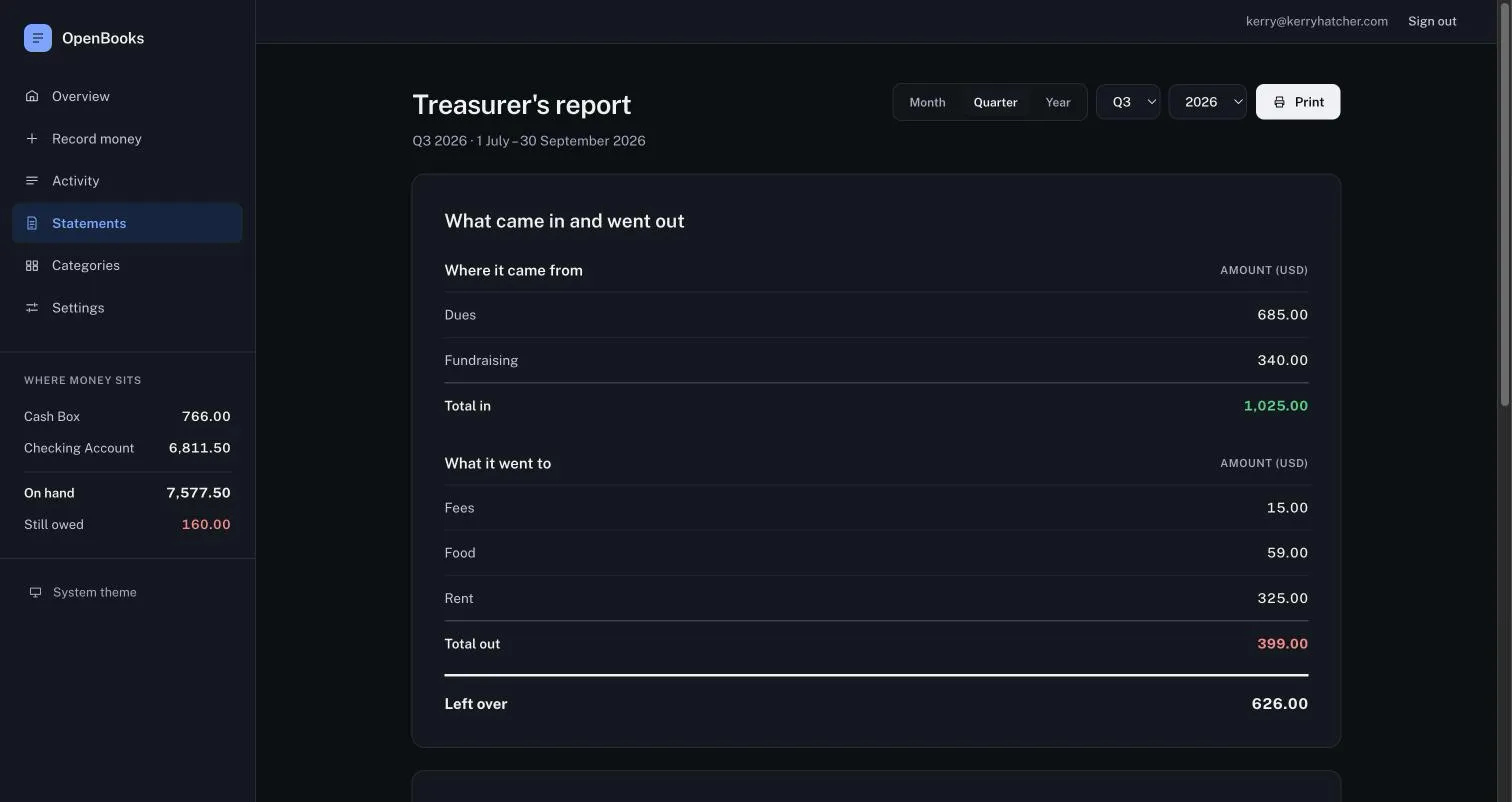
Pick the period. Print it. Hand it round.
An income statement, a balance sheet, and the balance of every account, over any month, quarter, or year, with the signs already flipped so every line reads positive. No line on it says "debit".
- Cash Box
- $766.00
- Checking Account
- $6,811.50
- On hand
- $7,577.50
Four ways in. One set of books.
Every client speaks to one API, in cents, and lets it flip the signs. Nothing re-derives a figure on its own.
The web app
Record from the form docked along the bottom of every page. Money on hand stays pinned to the sidebar.
just run
A desktop app
Native, caches locally, and goes read-only rather than lying to you when the server is unreachable.
just desktop
A terminal
Four tabs, money on hand always in the header. Give it a subcommand instead and it becomes a quiet, scriptable CLI.
just cli
An agent
The reports and the posting are exposed as MCP tools, so a coding agent can act as treasurer in plain language.
POST /mcp
Your books, straight, by the next meeting.
You can run it yourself today — one command, and the books are yours on your own machine. Hosting, with nothing at all to install, is coming.
MIT licensed. Reading first is fine too —the docs start with what a treasurer actually does.